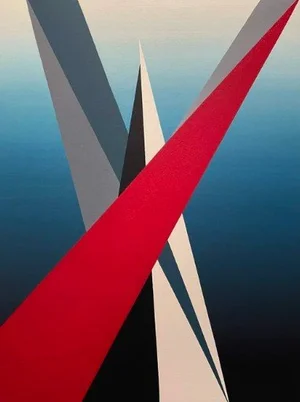
I paint abstract works in acrylic on stretched canvas, so it may seem odd that one of the strongest influences on my eye is a streetwear label. But the first time I walked through Harajuku, I realised that BAPE and my studio were working with the same raw materials: colour, pattern and rhythm.
Where BAPE Began
BAPE, short for A Bathing Ape, was founded by Nigo in Tokyo in 1993. It grew out of Harajuku’s street scene and became one of the most recognisable names in global streetwear, built on limited releases, bold graphics and a fiercely loyal community.
What interests me most is how deliberately the brand controlled scarcity. Small runs, specific stores and sold-out drops meant that owning a piece told people you were paying attention. That idea of an object carrying a story, and not just a function, is one I think about constantly at Studio Jacobson.
Camo as Abstraction
BAPE’s signature camouflage is the part that speaks to me as a painter. Camo started as a practical pattern, designed to make things disappear. BAPE turned it into something designed to be noticed, recoloured in bright, unexpected palettes.
Look at it closely and it has no subject. There’s no figure and no landscape, just overlapping shapes, irregular edges, repetition and colour relationships. That is the vocabulary of abstract art.
When I work on a canvas, I’m thinking about the same questions:
How do shapes sit against each other?
How much repetition is too much, and how much is not enough?
Which colours push forward, and which recede?
Where does the eye rest?
BAPE answers those questions across fabric. I answer them across a stretched canvas.
Pattern, Repetition and the Single Mark
The real difference between BAPE and my work is repetition. A BAPE design is made to be reproduced, worn by many people and recognised across a crowd. Its power comes from being one of many.
An original painting works the other way around. Each layer of acrylic is a decision that happens once and can’t be repeated exactly. Its power comes from being one of one.
Neither approach is better. They offer different things: belonging in one case and singularity in the other. I find that tension creative rather than contradictory. Studying how a pattern can become an icon through repetition makes me think harder about what makes a single, unrepeatable mark worth making.
Colour as Identity
Part of BAPE’s strength is that you can recognise it from across the street, often by colour and pattern alone. Colour works like a signature.
Abstract painting depends on the same principle. With no recognisable subject, colour carries the emotion and the identity of the work. A limited palette, a surprising pairing or a single bold block can say more than a detailed scene. Streetwear taught me not to be shy about that kind of confidence, and it’s something I bring into my palette choices at the easel.
Collecting as a Creative Practice
Streetwear fans and art collectors share a habit: they look closely. They notice stitching, finish, proportion and colour. They care about where something came from and why it was made.
That attentiveness is what I hope people bring to original art, too. Whether you’re hunting for a rare release or choosing a painting for your wall, you’re doing the same thing, looking for an object that feels like it belongs to you.
Bringing Street Culture Into the Home
Interiors are increasingly shaped by the same influences that shape fashion. A few ways to let that energy into a room:
Pick a palette from the pattern. Pull a colour from a favourite camo or graphic print and echo it in an abstract canvas.
Let one piece lead. A large original painting can anchor the room, with smaller, playful pieces around it.
Mix high and low. An original artwork beside a pop-culture collectable creates a space with personality.
Keep it considered. A few well-chosen items beat a crowded wall every time.
Final Thought
BAPE reminded me that pattern, colour and rhythm belong to everyone, from the street to the studio. A camo hoodie and an abstract painting may look nothing alike, but both begin with the same question: what happens when colour and shape are allowed to speak for themselves?
At Studio Jacobson, that’s the question I keep painting.
Interested in original abstract work? Take a look around the studio.