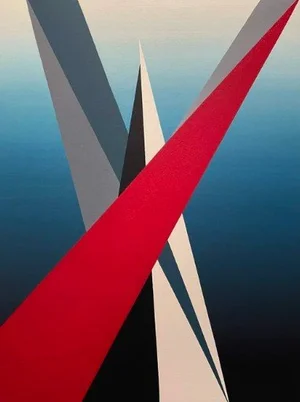
I paint one-off abstract works in acrylic on stretched canvas, and I collect mass-produced bears. That sounds like a contradiction, but the two sit side by side in my studio and speak to each other all day. This is how it started.
A Trip to Harajuku
It began in Tokyo. On a trip to Japan, I wandered into the Medicom Toy store in Harajuku, home of the BE@RBRICK, and walked out a different kind of collector. Shelves of glossy, blocky bears stood in rows, each wearing a different artist’s vision, and I couldn’t stop looking.
The Bearbrick was created by Medicom Toy in 2001. The design is almost absurdly simple: a minimal, architectural body with no expression and no backstory. That makes it a blank canvas, and KAWS, Basquiat, Warhol, Keith Haring, fashion houses and streetwear labels have all poured their visual language into the same small form.
As a painter, I recognised something immediately. The bear’s body never changes, but what artists do with it does. I work the same way. My constant is the stretched canvas, a fixed rectangle, and everything that happens inside it is the art.
The Scale of Obsession
Collectors talk about Bearbricks in percentages. The palm-sized 100% is the entry point, the 400% is the classic display size, and the 1000%, standing around 70 cm tall, is a full sculptural statement. My collection started with a single figure from that Tokyo trip and, as collectors will recognise, did not stay a single figure for long.
Edition vs. Original: What’s the Real Difference?
This is the question I get asked most, and I think the answer is more interesting than “one is real art and the other isn’t.”
A Bearbrick is one of many.
It’s made in limited runs, so each design exists as an edition.
It’s part of a shared language. Owning one connects you to a global community of collectors.
It’s accessible, often the most affordable way to own a piece of an artist’s world.
It’s comparable. Identical bodies let you see exactly how different creators solve the same problem.
An original painting is one of one.
It’s made once, by hand, and never repeated.
Every layer of acrylic records a decision, a mood and sometimes a happy accident.
The relationship is personal, directly between the artist and the person who lives with it.
It’s irreplaceable. There is no second copy.
Neither is better. They answer different needs. An edition offers belonging, and an original offers singularity. One says “I’m part of something,” and the other says “this exists only here.”
Abstract Art and the Blank Canvas Principle
Abstract work has no subject to hide behind. There’s no bear, no face, no landscape, only colour, texture, gesture and balance. That’s what the Bearbrick taught me to appreciate from the other direction. Its face is blank on purpose, and an abstract painting asks you to bring your own meaning to it too.
Both invite the viewer in. A Bearbrick lets you project a culture, a brand or an artist onto a neutral form. An abstract canvas lets you project a feeling.
What Each One Taught the Other
Collecting has changed how I paint. Seeing hundreds of artists respond to one fixed shape showed me how much power constraint can have, and it made me braver about letting a limited palette or a simple composition carry a whole piece.
Painting has changed how I see my collection. I now notice the craft in a finish, the confidence in a colour block and the restraint in a pattern. Colours and shapes I’ve admired on a Bearbrick sometimes find their way into my work, too.
Mixing Both in Your Home
The most interesting interiors I see don’t pick a side. They combine both:
Let the painting lead. Give a large abstract canvas the main wall. It sets the mood of the room.
Let the bears play. Place Bearbricks on a console, shelf or sideboard beneath or beside it, so they add colour, humour and pop-culture energy.
Echo the palette. Pull a colour from the canvas into your figures, or the reverse, so the two feel like a conversation instead of a collision.
Mind the scale. A large 1000% figure can anchor a corner like a sculpture. Smaller figures suit shelves and ledges.
Give everything space. One or two considered pieces make a bigger impact than a crowded surface.
Light it well. Glass cabinets, floating shelves and soft lighting show off detail. Keep both paintings and Bearbricks out of direct sun, because UV can fade finishes.
Starting Your Own Collection
Buy what you love. Prices fluctuate like any collectable market, so treat resale value as a bonus.
Buy from reputable sellers. Fakes are common.
Keep the packaging if long-term value matters to you.
Start small. A 100% figure is a great first step.
Add an original. Pair something from an edition with something made once and see how they change each other.
Final Thought
That day in Harajuku showed me that creativity can thrive inside a shared form. Every day at the easel reminds me that some things are meant to exist only once. At Studio Jacobson, I get to live in both worlds, and I think the best spaces do too.
Interested in the original abstract work I make? Take a look around the studio.